




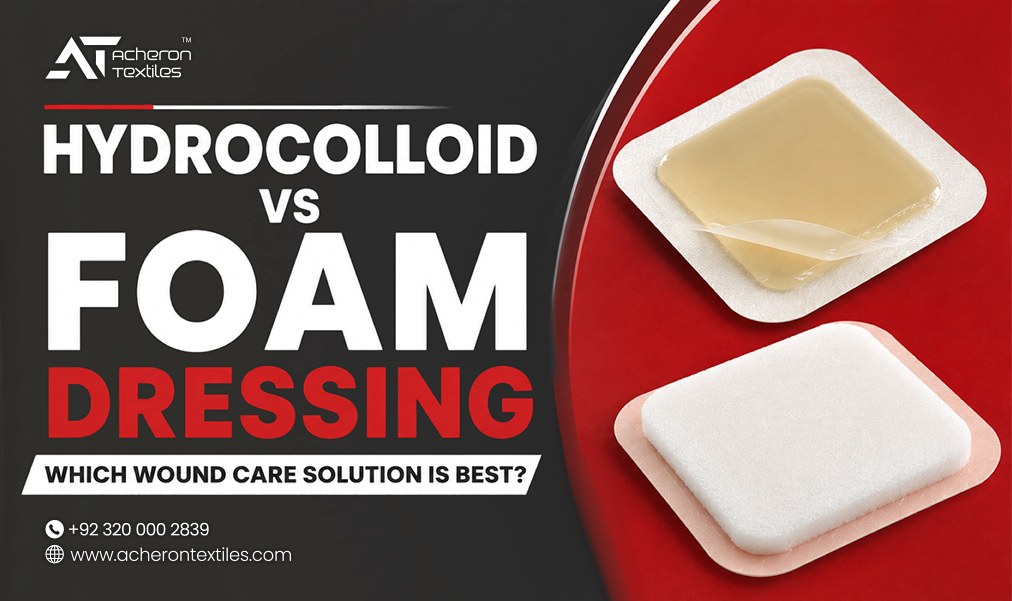
Proper wound care is essential for accelerating healing, reducing the risk of infection, and improving patient comfort. Among the many dressing types available today, hydrocolloid and foam dressings are the most popular ones. This guide aims to compare Hydrocolloid vs Foam Dressing, highlighting their uses, benefits, and limitations to help healthcare professionals choose the right one for their wound management needs.
What is a Hydrocolloid Dressing
A Hydrocolloid dressing is a self-adhesive film made of gel-forming agents, including gelatin, pectin, and carboxymethylcellulose. When applied to a wound, it interacts with wound exudate to form a soft, moist, and protective gel layer.
Uses
-
Hydrocolloid dressing is commonly used for
-
Minor burns
-
Superficial pressure injuries
-
Abrasions and lacerations
-
Low exudate post-operative wounds
-
Epithelializing wounds
Benefits
-
Excellent adhesive properties without additional tape required
-
Supports autolytic debridement
-
Allows patients to shower without removing or changing the dressing
-
Promotes a moist wound healing environment
Limitations
-
Not appropriate for heavily exuding wounds, third-degree burns, or clinically infected wounds
-
Limits vapor transmission
-
May cause skin irritation
-
Not suitable for deep cavity wounds
What is a Foam Dressing
A foam dressing is a highly absorbent polyurethane layer usually made from open-cell polyurethane or silicone foam. This dressing is designed to manage moderate-to-heavy wound exudate while maintaining a moist wound-healing interface. Also, it is available in both adhesive and non-adhesive variants to suit skin fragility levels and all wound types.
Uses
Foam dressing is commonly used for
-
Pressure injuries
-
Chronic wounds
-
Leg ulcers
-
Moderate to heavy exuding wounds
-
Diabetic foot ulcers
-
Post-operative wounds
Benefits
-
Ensures extended wear stability
-
Ideal for wounds with moderate to heavy drainage
-
Thermal insulation for faster healing
-
Rapid wicking of fluid away from the skin, minimizing infection risk.
-
Superior absorption capacity
-
Reduces strike-through risk
-
Provides cushioning and comfort
Limitations
-
May require frequent changes
-
Higher cost than traditional dressings
-
Not ideal for dry wounds
-
Limited debridement ability
-
Less durable in high-friction areas
Hydrocolloid vs Foam Dressing: Major Differences
Let’s evaluate the key differences between the hydrocolloid and foam dressing for a better understanding:
Absorption Capacity
One of the major differences between hydrocolloid and foam dressings is their ability to manage wound exudate.
-
Hydrocolloid dressing: Suitable for low to moderate exudate and becomes oversaturated in highly draining wounds.
-
Foam dressing: Suitable for moderate to heavy exudate, offering superior fluid absorption and helping prevent skin maceration.
Adhesive Properties
The adhesive properties of a dressing determine how effectively it remains in its place.
-
Hydrocolloid dressing: It has a strong adhesive backing, provides a waterproof seal, and usually does not require secondary fixation.
-
Foam dressing: Available in both adhesive and non-adhesive variants. Non-adhesive foam is excellent for skin protection on fragile skin.
Durability Comparison
A durability comparison helps determine replacement frequency and dressing longevity.
-
Hydrocolloid dressing: It is highly durable and remains in place for several days because it is waterproof and sticky.
-
Foam dressing: less durable than hydrocolloid dressing and may require more frequent changes in heavily draining wounds.
Skin Protection
Protecting surrounding tissue is a crucial part of effective wound management.
-
Hydrocolloid dressing: Protects wounds from friction and external contamination and may cause skin irritation in individuals with sensitive skin.
-
Foam dressing: It provides a gentle cushioning effect and offers excellent skin protection for delicate or vulnerable tissue.
Moist Wound Healing
Moisture management is an integral part of wound healing, promoting faster, more efficient recovery while reducing the risk of complications.
-
Hydrocolloid dressing: It forms an occlusive barrier that promotes faster epithelialization and creates a sealed healing environment.
-
Foam dressing: It helps maintain a moisture balance without excessive wound hydration.
Hydrocolloid vs Foam Dressing: Comparison Table
|
Features |
Hydrocolloid Dressing |
Foam Dressing |
|
Exudate level |
Dry to low exudate |
Moderate to high |
|
Wear time |
Longer |
Moderate |
|
Durability comparison |
Superior |
Good |
|
Waterproof barrier |
High |
Varies |
|
Cushioning effect |
Limited |
Stronger |
|
Absorption capacity |
Low to moderate |
Moderate to heavy |
|
Adhesive properties |
Strong self-adhesive |
Adhesive or non-adhesive |
|
Skin protection |
Good |
Excellent |
|
Cost |
Generally lower per unit |
Slightly higher per unit |
|
Best for |
Superficial wounds |
Chronic wounds, pressure injuries |
When to Use Each Dressing Type
When choosing a surgical dressing, professional buyers and care providers must consider:
-
Expected exudate levels
-
Wound type and depth
-
Skin sensitivity
-
Infection risk
Choose a hydrocolloid dressing if
-
You need a waterproof solution.
-
The wound has low to no drainage.
-
Treating superficial wounds such as minor burns, pressure ulcers, and abrasions.
-
The patient is mobile and needs durability.
Choose foam dressing if
-
The wound has moderate to heavy drainage.
-
You need a sterile application for a deep cavity.
-
When high absorption capacity is required.
Conclusion
The choice between hydrocolloid and foam dressing ultimately depends on the wound’s characteristics and healing requirements. A hydrocolloid dressing is suitable for closed surgical incisions with minimal drainage, providing a waterproof barrier and supporting the patient’s mobility. On the other hand, a foam dressing excels in managing moderate to heavy exudate or any procedure site expected to produce active drainage in the immediate post-operative period, providing exceptional comfort and skin protection.