



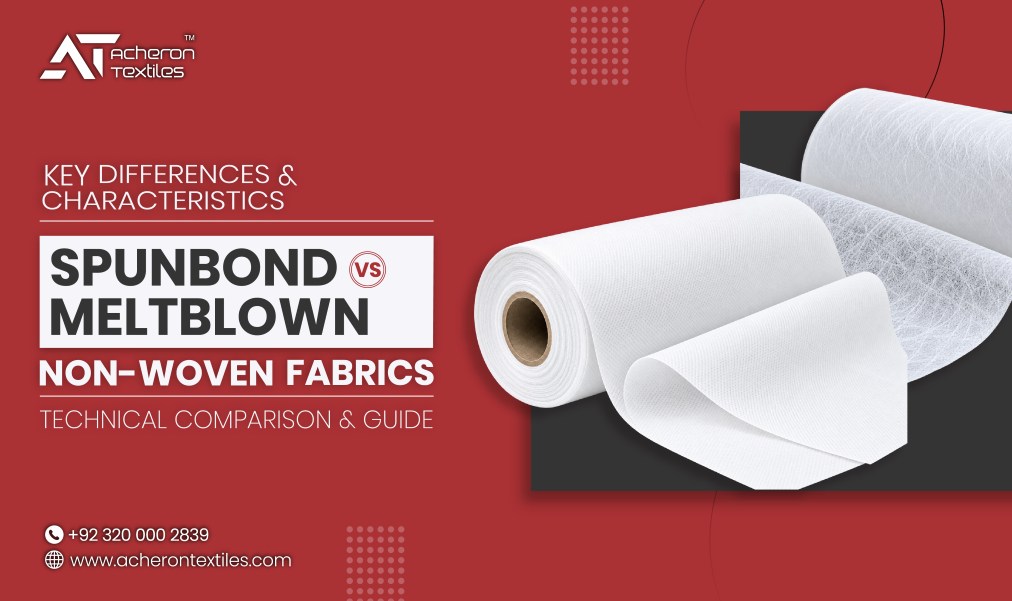
Non-woven fabrics have become an integral part across multiple industries, including hygiene, healthcare, agriculture, filtration, packaging, and industrial applications. Non-woven fabrics are produced by bonding fibres or filaments together through thermal, chemical, or mechanical methods. Spunbond and meltblown are the two most widely used technologies for manufacturing non-woven fabric because of their benefits and functionality. This blog explains the difference between spunbond vs meltblown nonwoven fabrics to help you choose the right material for the job. Let’s begin!
Understanding Spunbond Non-Woven Fabrics
Spunbond non-woven fabrics are produced by extruding propylene filaments through nozzles and spinnerets. These filaments are then stretched, laid down in a random web, and bonded together using pressure or heat. This manufacturing process results in a lightweight, durable material with high tear resistance, mechanical strength, and flexibility.
Characteristics of Spunbond Non-woven fabrics
-
High tensile strength
-
Excellent tear resistance
-
Good dimensional stability
-
Good flexibility
-
Breathable
-
Cost-effective
Applications of Spunbond Non-woven Fabrics
-
Hygiene products (outer diaper layer, disposable items)
-
Healthcare and medical products (surgical gowns, masks, patient gowns, bed sheets)
-
Agriculture (crop covers, seed bags, plant protection fabrics)
-
Packaging (gift bags, shopping bags, and reusable bags)
-
Industrial applications (filtration media, protective covers)
-
Filtration (pre-filter layers, liquid filtration systems)
Understanding Meltblown Non-Woven Fabric
Meltblown non-woven fabrics are manufactured using a molten polymer extruded through extremely fine openings or nozzles. Afterwards, the resultant material is immediately blasted with high-velocity hot air, which stretches the polymer into extremely fine fibres ranging between 1 micron and 5 microns. These microfibres are then collected on a collection screen, forming a dense web over a large surface area. This ultra-fine fibre structure gives meltblown non-woven fabric excellent filtration capabilities, absorbency and softness.
Characteristics of Meltblown Non-woven fabrics
-
Strong barrier properties
-
Lightweight construction
-
Excellent filtration capability
-
Ultra-fine fibre diameter
-
Excellent liquid absorption
-
Softer and delicate
-
Lower mechanical strength
Applications of Meltblown Non-Woven Fabrics
-
Medical applications (surgical gowns, surgical and N95 face masks)
-
Hygiene products (functional layers in feminine hygiene products, diapers, wipes)
-
Air filtration (vacuum filters, HVAC filters)
-
Liquid filtration (filters oil, water and other liquids)
-
Absorbent products (Cleaning wipes and oil-absorbent pads)
Spunbond vs Meltblown Non-Woven Fabrics: Key Differences
Although spunbond and meltblown non-woven fabrics look alike, they serve distinct purposes and have different characteristics. Let’s find out which key factors make them different from each other.
Manufacturing Processes
The major difference between spunbond and meltblown non-woven fabrics is their manufacturing process. Spunbond extrudes continuous filaments, which are then stretched and laid onto a moving conveyor. This procedure results in a web-like structure that is then bonded using heat or pressure to create a durable, strong non-woven fabric.
On the other hand, the meltblown manufacturing process involves using high-velocity air to blow molten polypropylene, resulting in fine, randomly arranged fibres. These fibres are then collected on a conveyor, forming a dense web that bonds together naturally without additional processing.
Air Permeability and Breathability
Spunbond non-woven fabrics have a relatively open structure that readily promotes airflow, which makes them a good choice for breathable fabrics. The exceptional air permeability of spunbond fabric makes it ideal for products that require better airflow, such as agricultural covers, medical gowns, and comfort products.
Meltblown nonwoven fabrics have a dense microfibre and complex pore structure that resist airflow and reduce air permeability. However, the air permeability of meltblown fabrics depends on various factors, including fibre diameter, web density, and processing conditions.
Barrier Properties
The barrier properties of nonwoven fabrics are an important consideration when choosing for protective applications. Spunbond material provides structural support and particle resistance while improving abrasion resistance and strengthening the overall material. However, the primary advantage of spunbond fabric is mechanical support rather than high-efficiency filtration.
In contrast, meltblown provides an effective barrier against microbial particles, aerosols, and liquids compared to spunbond alone. This characteristic makes them highly effective for filtration and ensures excellent barrier protection.
Moisture Management
Moisture management is an important approach where spunbond and meltblown fabrics complement each other. Spunbond nonwoven materials are usually used as structural or protective layers, as their open structure allows vapour to escape more easily, resulting in low water absorption.
On the other hand, the fine capillary structure of meltblown nonwoven fabric pulls moisture away from the skin and holds it. These structures can be engineered for filtration, liquid handling, and absorption-related applications. Moreover, the SMS combination (Spunbond-Meltblown-Spunbond) is a layered construction in which a delicate meltblown layer is sandwiched between two strong spunbond layers. This layer provides a useful combination of filtration efficiency, strength, and barrier protection and is often used in air filtration systems, surgical masks, and medical protective garments.
Bonging Techniques
Different bonding techniques are used for both fabrics, defining their specific characteristics. Spunbond technology typically uses thermal calendaring with heated rollers to fuse the filaments at crossover points, along with ultrasonic bonding.
Meltblown fabrics, by contrast, produce fine fibres that are used directly as filtration layers or combined with other nonwoven materials to provide structural reinforcement using thermal or other lamination techniques.
Spunbond vs Meltblown Non-Woven Fabrics Head-to-Head Comparison
|
Features |
Spunbond |
Meltblown |
|
Fibre-size |
Continuous filaments |
Ultra-fine microfibers |
|
Texture |
Strong and durable |
Fragile and soft |
|
Air Permeability |
Higher |
Lower than spunbond |
|
Breathability |
Excellent |
Moderate |
|
Water Resistance |
Good |
Limited |
|
Barrier properties |
Good |
Excellent |
|
Best Use |
Outer layer, surgical gowns, packaging |
masks, filters, barrier and absorbent layers |
Antimicrobial Properties and Surface Treatments
Neither spunbond nor meltblown polypropylene is inherently antimicrobial. Instead, antimicrobial properties typically come from the addition of specialised coatings, agents, or surface treatments. Surface treatments include coatings of silver ions, quaternary ammonium compounds, or other antimicrobial agents that benefit applications in healthcare and hygiene products. Moreover, it reduces the microbial growth on the fabric surface over time, which in turn reduces cross-contamination risk and enhances the durability of protective garments.
Surface treatments are generally designed for:
-
Reducing microbial growth.
-
Enhancing liquid repellency
-
Improving odor control.
-
Improving printability.
-
Improving resistance to specific contaminants.
Spunbond vs Meltblown Non-Woven Fabrics-Which One to Choose
The choice between spunbond and meltblown depends on the particular applications and desired performance.
-
Choose spunbond if you need high mechanical strength, improved breathability and durability, such as outer layers, agricultural covers, packaging and structural components.
-
Choose meltblown if you need barrier performance, filtration, and fine-particle capture, including oil absorbents, mask filters and fine filtration media.
Final Thoughts
The debate of spunbond vs meltblown nonwoven fabrics comes down to various factors and desired performance. Although spunbond and meltblown nonwoven fabrics often look alike, their structures and performance characteristics significantly differ. Spunbond technology produces continuous filaments that offer flexibility, strength and durability, while meltblown technology creates ultra-fine fibres that provide excellent barrier properties and filtration. Understanding the material properties, manufacturing processes, and performance characteristics helps buyers to choose the right nonwoven fabric for the job.
Acheron Textile offers a wide range of nonwoven fabrics for a variety of applications, with a strong focus on sustainability practices. By combining reliability, durability, and sustainable manufacturing practices, we deliver high-quality nonwoven fabrics that meet your desired performance requirements while supporting environmental objectives.